
TRENOS SiGINT: SIAL Shanghai And The Industrialisation Of Wellness
Signal
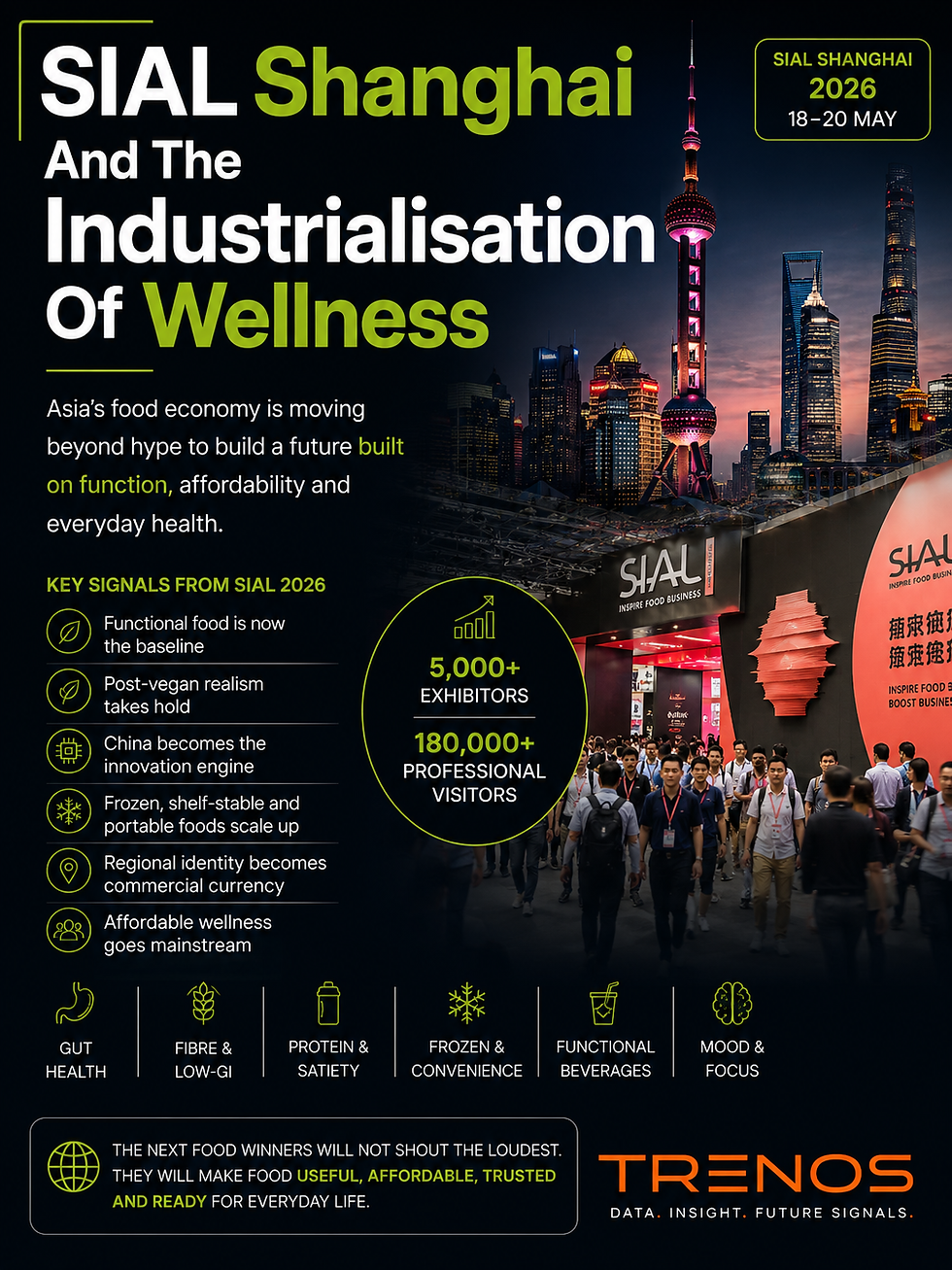
SIAL Shanghai 2026 may ultimately be remembered as the moment Asia’s food economy visibly shifted from premium aspiration toward functional necessity. What emerged across the exhibition was not simply “health food.” It was the industrialisation of wellness itself: scalable systems designed to embed protein, fibre, hydration, metabolic support and convenience into ordinary everyday eating.
The strongest commercial signals came from products solving practical modern pressures like urban faigue, ageing populations, rising metabolic concerns, convenience dependency, shrinking meal prep time and cost of living stress.
South Korean dairy giant Namyang’s TakeFit Monster Protein Beverage and TakeFit MAX lines exemplified this shift perfectly. These were not niche sports products. They were mass-market portable nutrition systems designed around satiety, portability and functional everyday use. Meanwhile exhibitors including Huai’an Lengka highlighted low-fat, plant-based and wellness-oriented formats focused less on ideology and more on digestive comfort, balance and body management.
Perhaps the biggest signal came from China itself. Agricultural heavyweight Beidahuang demonstrated how large-scale industrial food systems are now moving aggressively into functional nutrition and wellness positioning. In parallel, SIAL highlighted emerging Ai-powered ingredient systems and Ai-assisted food innovation, not as futuristic gimmicks, but as tools for faster formulation, nutritional optimisation, shelf-life engineering and scalable product development.
The deeper TRENOS signal is this: Asia no longer appears interested in merely importing premium Western food narratives. It is building an entirely new food operating system, one based around practical wellness, resilient logistics, affordable functionality and industrial speed.
Human Factor
Consumers across Asia are exhausted by complexity. They do not necessarily want extreme diets, ideological food wars or expensive wellness rituals. They want foods that quietly help them function better:
more stable energy
less sugar
better digestion
higher satiety
convenience without guilt
trusted ingredients
products that fit modern urban life
That emotional shift may become one of the defining consumer behaviour changes of the next decade.
TRENOS Metrics Snapshot
Field | Signal |
Signal | Asia’s food economy shifts toward scalable functional wellness systems |
Data Point | SIAL Shanghai 2026 hosted ~5,000 exhibitors and ~180,000 professional visitors |
TikTok Views | Not verified |
Retail Footprint | China, Korea, Southeast Asia, Japan, wider Asian export corridors |
Ingredient Format | Functional beverages, shelf-stable dairy, protein snacks, low-GI foods, fibre systems, hydration beverages |
Product Range | TakeFit Monster Protein Beverage, TakeFit MAX, protein popcorn, puffed chickpeas, protein puddings, wellness beverages |
Consumer Segment | Urban professionals, ageing consumers, middle-income wellness shoppers, convenience-led households |
Brand Origin | China, South Korea, pan-Asian innovation ecosystem |
Export Status | Strong implications for ANZ dairy, marine bioactives, horticulture and foodtech exports |
Trend Classification | Industrialised Wellness Economy |
System Pressure Point | Commodity exporters risk losing value capture to Asia-led branded wellness systems |
Momentum | Very high |
Sentiment | Pragmatic, commercially optimistic, highly scalable |
Where Signal Is Loudest | Functional beverages, portable protein, shelf-stable nutrition, AI-supported formulation |
Related Links | SIAL Shanghai, SIAL Innovation, SIAL Global Food Industry Summit |
Long Play Analysis - SIAL Shanghai And The Industrialisation Of Wellness
The Western future food narrative spent much of the last decade focused on disruption language - alternative proteins, ethical eating, food replacement systems and climate positioning. SIAL Shanghai suggests Asia is taking a more commercially grounded route. The emerging winners are not necessarily the loudest innovators — they are the companies capable of delivering affordable functionality at industrial scale.
This changes the opportunity map for ANZ dramatically. The next growth categories may not simply be milk powder, bulk meat exports or raw horticulture. They may increasingly involve:
shelf-stable protein systems
low-GI dairy technologies
functional marine ingredients
gut-health beverages
AI-assisted ingredient design
hybrid protein systems
export-ready wellness foods built specifically for Asian metabolic and demographic realities
The strategic danger for ANZ is becoming trapped as a raw material supplier while Asia captures the higher-margin layers of formulation, branding, health positioning and retail integration. China, Korea and Southeast Asia increasingly appear willing to move faster, iterate harder and industrialise wellness more aggressively than many Western markets anticipated.
SIAL Shanghai 2026 therefore may not simply represent a trade exhibition. It may represent the visible emergence of Asia’s next food operating system which is practical, scalable, wellness-oriented and built for the pressures of modern urban life.


Comments