
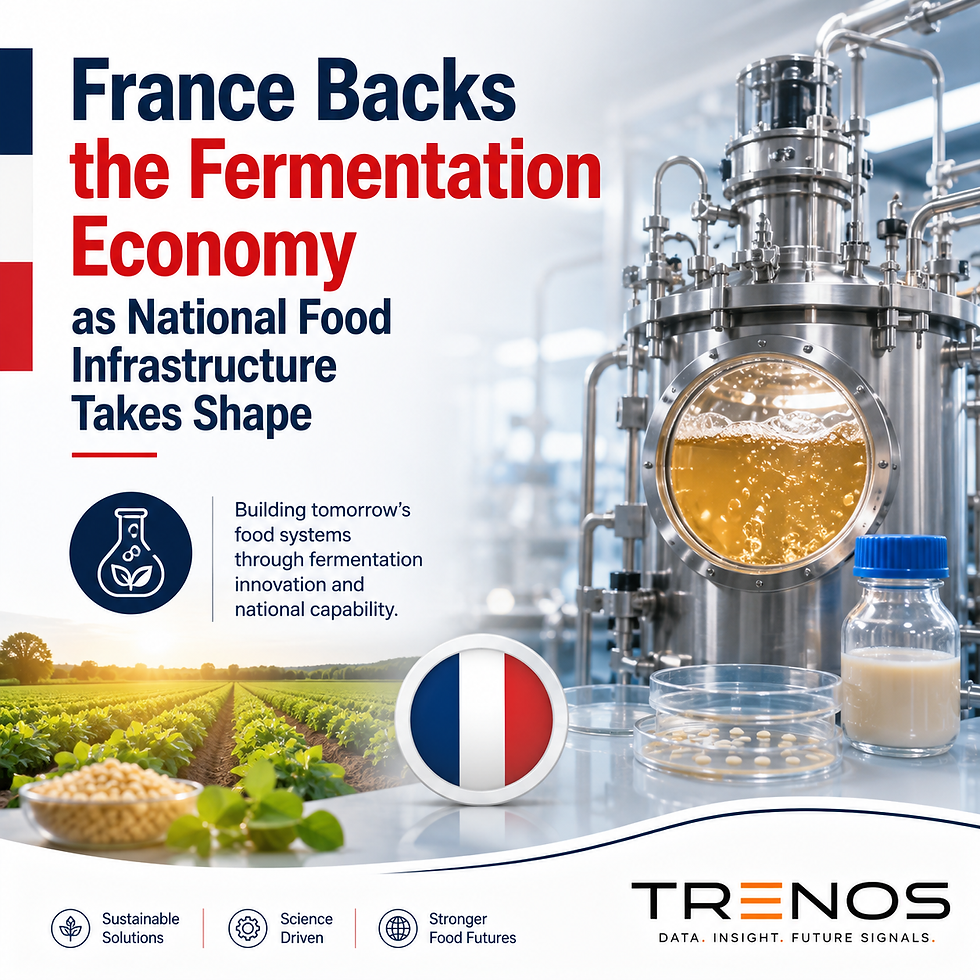
France Backs the Fermentation Economy as National Food Infrastructure Takes Shape

SIGNAL
France is no longer treating fermentation as a niche food technology.
It is treating it as national capability. This represents a subtle but important evolution in government thinking.
The first wave of investment focused on supporting innovative companies.
The second wave is building the infrastructure those companies will eventually require.
That distinction matters.
HUMAN FACTOR
Consumers are unlikely to notice another government research programme.
They will notice better tasting foods, improved nutrition, longer shelf life, lower production costs and more resilient food supplies. Those outcomes depend on infrastructure built years before products reach supermarket shelves.
Like roads, ports or fibre networks, fermentation infrastructure is largely invisible until the economic benefits begin to flow.
TRENOS Metrics Snapshot
Metric | Assessment |
Government Commitment | Very High |
Infrastructure Development | Accelerating |
Public-Private Collaboration | Expanding |
Commercial Readiness | Moving from Pilot to Scale |
Global Competitive Pressure | Increasing |
Opportunity for ANZ | High, but narrowing |
LONG PLAY - France Backs the Fermentation Economy as National Food Infrastructure Takes Shape
One of the clearest signals emerging during 2026 is that precision fermentation is moving beyond venture capital.
Five years ago, headlines were dominated by funding rounds.
Today, the headlines increasingly concern:
national research programmes
pilot manufacturing facilities
AI-enabled strain engineering
industrial bioprocessing
food security
sovereign manufacturing capability
That is the transition from an emerging technology to an emerging industry.
Countries establishing fermentation infrastructure today are positioning themselves to capture tomorrow's high-value manufacturing, intellectual property and export markets.
Those waiting risk becoming technology importers rather than technology exporters.
This is remarkably similar to what occurred with semiconductor manufacturing, battery technology and renewable energy. Early investment was often questioned because demand appeared uncertain. Once global adoption accelerated, countries with established ecosystems gained a structural advantage that proved difficult for others to replicate.
For New Zealand, the opportunity may be particularly compelling. The country already combines agricultural expertise, renewable electricity, advanced food science and globally recognised food brands. What remains largely absent is a coordinated national strategy linking these strengths into a dedicated industrial biotechnology ecosystem.
France's latest investment therefore deserves attention not because of its size alone, but because it reflects a broader geopolitical shift. Governments are beginning to see fermentation not merely as food innovation, but as strategic economic infrastructure, an asset that could shape future exports, regional manufacturing, supply-chain resilience and long-term food sovereignty.
ENDS:


Comments