
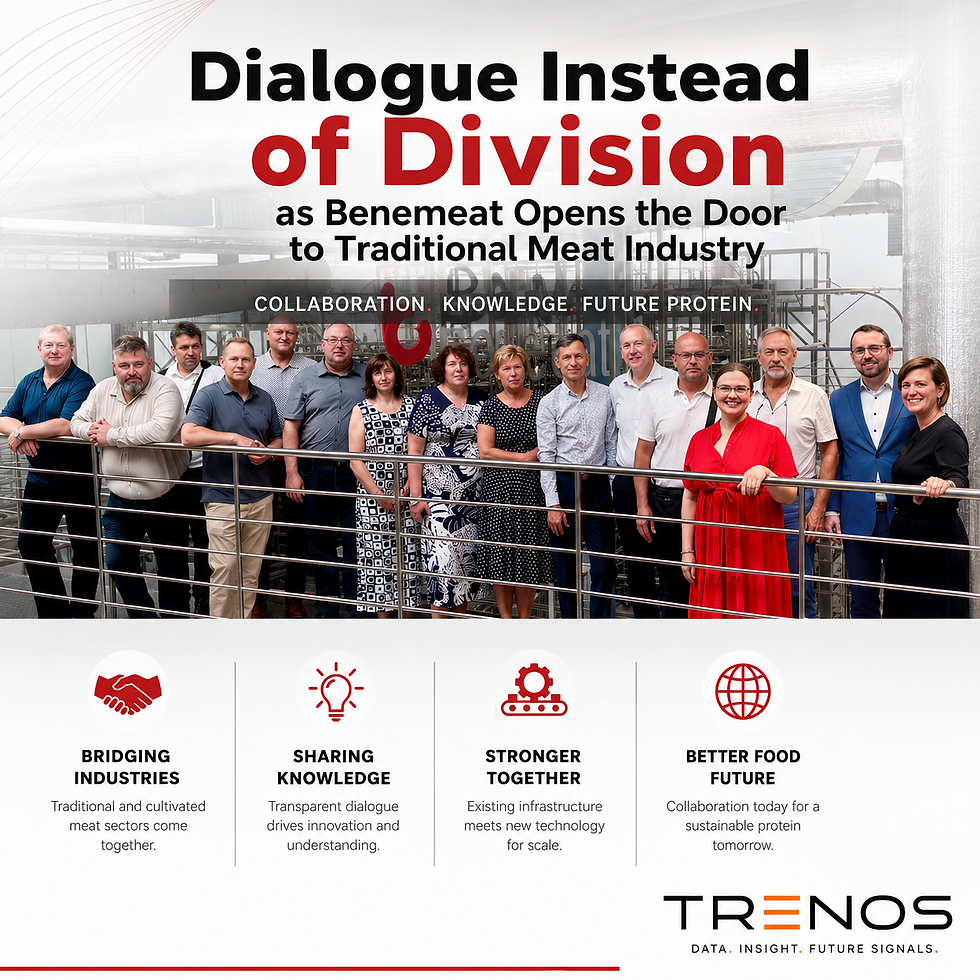
TRENOS SiGINT: Dialogue Instead of Division as Benemeat Opens the Door to Traditional Meat Industry

Signal
The cultivated meat industry appears to be entering a more pragmatic commercial phase.
Rather than positioning itself as a disruptive outsider, Benemeat is actively engaging established meat-sector stakeholders. This suggests the industry's commercialisation strategy is evolving from ideological competition towards industrial partnership.
Historically, many food technology sectors, from plant proteins to precision fermentation, have discovered that scaling is easier when existing supply chains become partners rather than opponents.
Human Factor
Consumers generally do not buy food because it represents a political movement.
They buy products that are trusted, affordable, safe and taste good.
If traditional meat companies begin participating in cultivated meat development instead of resisting it, consumer acceptance could accelerate simply because familiar brands and supply chains reduce perceived risk.
Trust often transfers faster through established food companies than through technology startups alone.
Metrics Snapshot
Indicator | Assessment |
Momentum | ▲ Increasing collaboration |
Industry Direction | Partnership replacing confrontation |
Commercial Signal | Existing processors becoming potential collaborators |
Strategic Importance | High for export-focused livestock nations |
NZ Relevance | Strong - could leverage existing meat processing capability |
Long Play - Dialogue Instead of Division as Benemeat Opens the Door to Traditional Meat Industry
This development could mark one of the most important strategic pivots yet for cultivated meat.
The first decade of the industry was characterised by language centred on disruption, replacement and "the end of conventional meat." That framing created understandable resistance from livestock producers whose businesses and identities appeared under threat. Benemeat's approach suggests a growing recognition that scaling globally may depend less on defeating the incumbent industry than on bringing it into the value chain.
For countries such as New Zealand, the implications are substantial. Companies like Silver Fern Farms, Alliance Group, ANZCO and other established processors already possess world-class processing plants, export relationships, food safety systems and premium market access. If cultivated meat technologies mature economically, these assets could become competitive advantages rather than stranded infrastructure. The future protein economy may be less about choosing between conventional and cultivated meat, and more about producing multiple forms of protein through integrated manufacturing systems.
The bigger signal is therefore cultural as much as technological. When companies begin replacing confrontation with dialogue, industries often move from speculative innovation towards commercial execution. In that sense, Benemeat may be signalling not simply a new communications strategy, but the beginning of a more mature phase for cultivated protein, one where collaboration, rather than disruption alone, becomes the route to scale.
ENDS:


Comments