
TRENOS SiGINT: Global Collagen Goes Cellular- Opo Bio Sees A New Zealand Opportunity
- Scott Mathias

- Jun 2
- 2 min read
Signal:
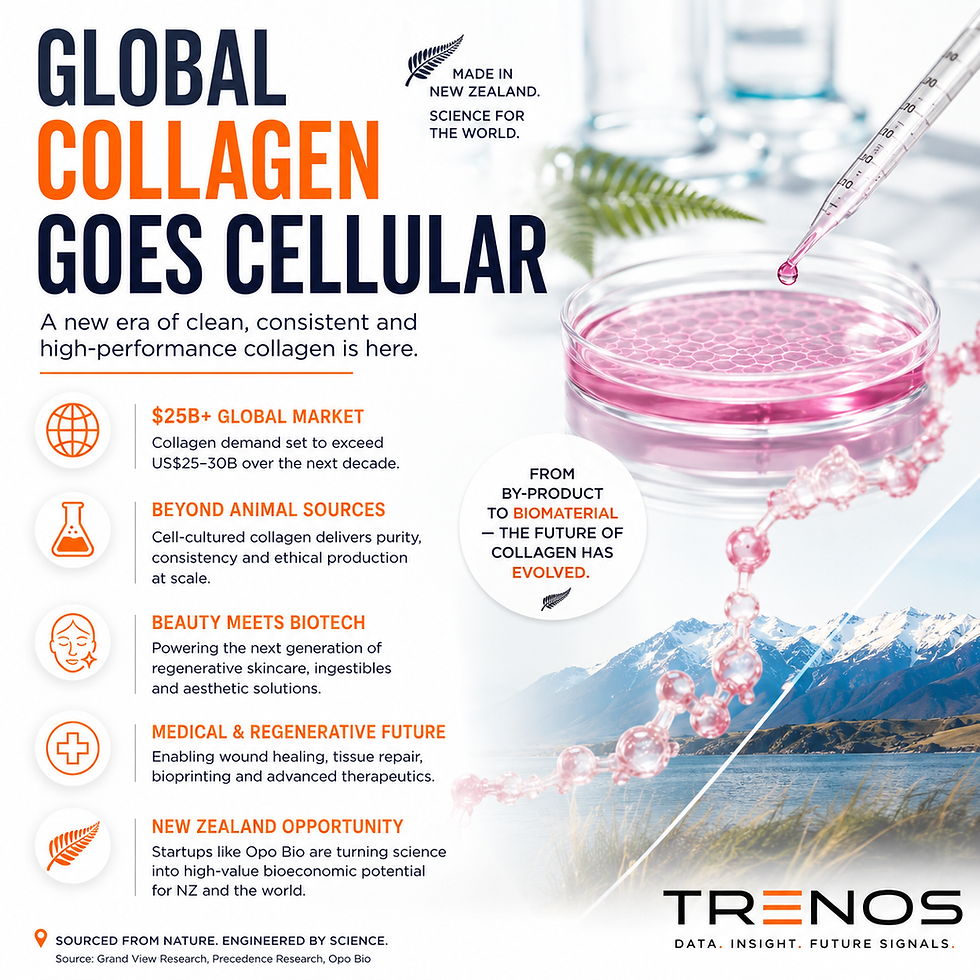
The global collagen industry is undergoing a structural transition from slaughter-derived ingredient extraction toward precision-engineered biomaterials. What was historically a by-product industry tied to meat processing is increasingly becoming a biotechnology category intersecting cosmetics, regenerative medicine, wound healing, tissue engineering and advanced skincare.
New Zealand startup Opo Bio sits directly inside this transition. Publicly, the company now frames itself around “next generation bio-based ingredients for cosmetic and medical applications” rather than cultivated meat cells alone. This reflects a broader sector move occurring globally - cell-culture infrastructure originally developed for cultivated meat is now being redirected toward higher-margin, lower-volume biomaterials with faster commercial pathways.
The global collagen market is forecast by various analysts to exceed US$25–30 billion over the next decade, while recombinant collagen alone is forecast for double-digit growth as beauty, medical and regenerative applications accelerate.
Human Factor
Consumers are no longer simply buying “anti-ageing”. They are buying regeneration, longevity and biological optimisation. Younger consumers in Asia, in particular, are increasingly seeking preventative skin-health treatments, while older demographics want tissue repair, healing and structural support. The same emotional drivers powering supplements and skincare - vitality, recovery and visible ageing reduction - are now converging with biotechnology.
This is why collagen matters. It sits at the intersection of vanity, wellness and medicine. It is both emotional and clinical.
TRENOS Metrics Snapshot
Metric | Observation |
Signal | Cell-cultured and recombinant collagen moving from niche biotech into scalable beauty and medical markets |
Data Point | Global collagen market projections now commonly exceed US$25B–30B over next decade |
Medical Opportunity | Wound healing, tissue scaffolds, dental repair, regenerative medicine, bioprinting |
Cosmetic Opportunity | Skin regeneration, ingestible beauty, collagen stimulators, regenerative skincare |
Technology Layer | Synthetic biology + industrial biomanufacturing + precision protein engineering |
NZ Strategic Advantage | Existing agricultural bio-IP reputation plus strong food science and biotech capability |
Consumer Driver | “Clean science” beauty, ethical sourcing, longevity culture, regenerative aesthetics |
Export Potential | High-value biotech ingredients rather than commodity agricultural outputs |
Asia Relevance | Korea, China and Japan accelerating regenerative skincare and biotech beauty demand |
Trend Classification | Bioeconomy Infrastructure Shift |
System Pressure Point | Cultivated meat economics remain difficult at food scale; biomaterials offer faster monetisation |
Momentum | Rising |
Sentiment | Quietly bullish |
Where Signal Is Loudest | Regenerative skincare, biotech cosmetics, wound care, tissue engineering |
Related Links | Opo Bio, regenerative medicine research, recombinant collagen markets |
Long Play -Global Collagen Goes Cellular- Opo Bio Sees A New Zealand Opportunity
This may ultimately become one of the most important post-hype pivots in the cultivated meat sector.
The original vision was always larger than burgers. The underlying technologies - cell culture, protein engineering, biomanufacturing and synthetic biology - were capable of producing far more than food. Collagen may simply be one of the first commercially realistic proof points where those technologies can generate sustainable revenue.
For New Zealand, the implications are larger again. The country cannot out-scale China or out-subsidise the United States. But it may be able to position itself as a trusted exporter of high-value biological systems, biomaterials and precision ingredients. That is a fundamentally different economic model from shipping milk powder and frozen meat offshore.
The deeper question now becomes whether New Zealand wants to remain a commodity agriculture economy or evolve into a bio-manufacturing nation.
ENDS:


Comments