
TRENOS SiGINT: The Zespri Paradox and New Zealand's Opportunity Horizon

Signal
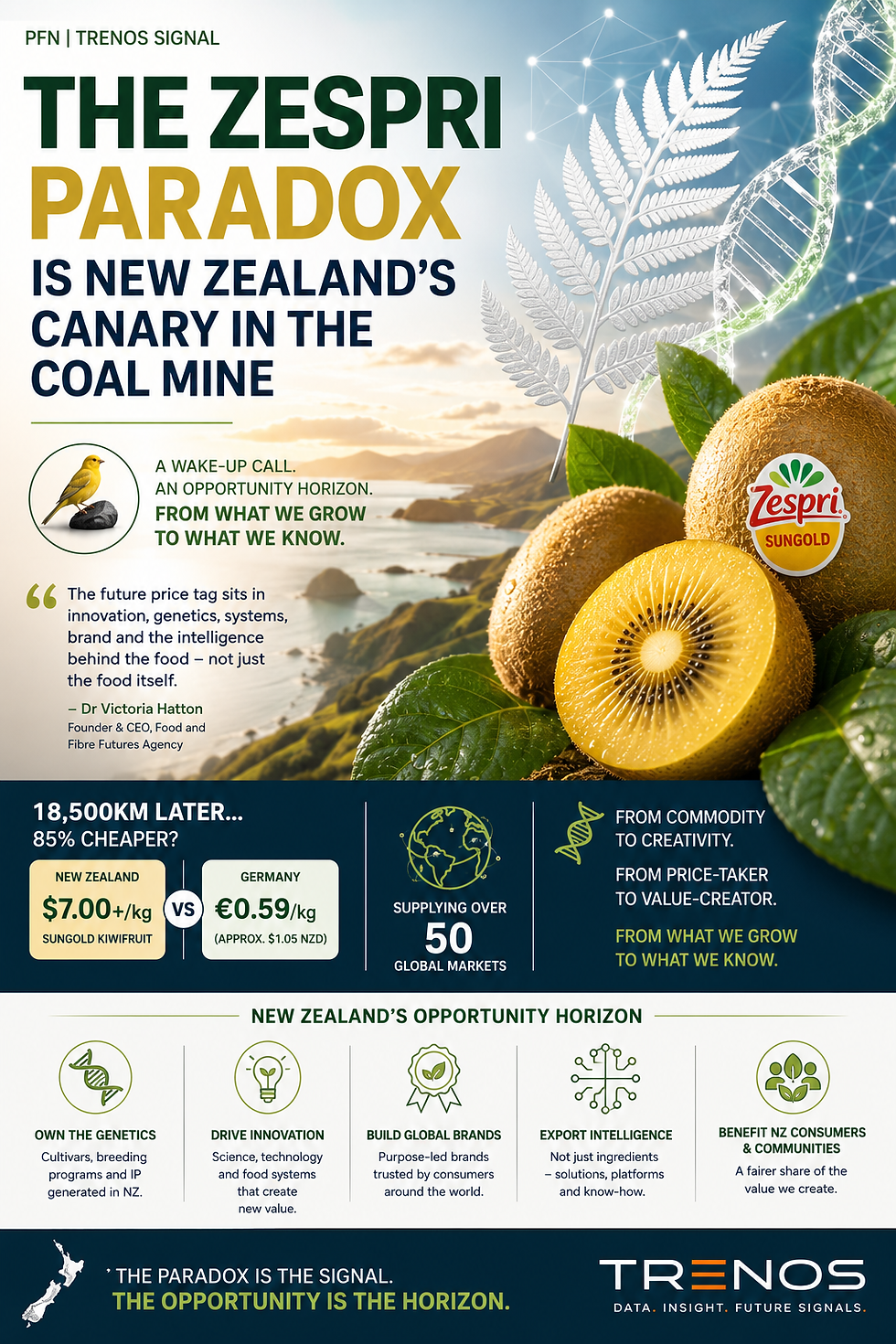
The discussion sparked by Business Intel specialist, Greg Moore's observations about Zespri pricing reaches well beyond kiwifruit. It exposes a structural feature of New Zealand's export economy. For decades New Zealand has been exceptionally good at producing biological commodities. The challenge is that commodity producers rarely capture the greatest share of value. The Zespri paradox story demonstrates both the risk and the opportunity.
On one hand, New Zealand consumers increasingly encounter situations where products grown locally are priced according to international demand rather than local affordability. Kiwifruit, butter, dairy and other export-oriented products are becoming examples of a system where global market success does not always translate into domestic benefit.
On the other hand, Zespri represents one of New Zealand's most successful transitions from commodity exporter to intellectual property owner. The company no longer sells fruit alone. It sells genetics, growing systems, quality assurance, logistics capability, brand trust and market access.
Food and Fibre Futures Agency Founder and CEO Dr Victoria Hatton believes this shift is central to New Zealand's future prosperity. "We've spent generations believing that the value of New Zealand is what we can grow on the land. That belief is now our biggest risk. The future price tag sits in innovation, in genetics, systems, brand and the intelligence behind the food, not just the food itself." Her observation aligns closely with the signal emerging from the Zespri paradox. The issue is no longer about how much fruit New Zealand grows. It is about who owns the biology, who owns the data, who owns the intellectual property and who captures the value.
The future wealth of New Zealand may not come from exporting more food. It may come from owning more of the intelligence behind food.
Human Factor
Consumers instinctively understand fairness. When locally produced butter is cheaper overseas than at home, or a Bay of Plenty kiwifruit can be purchased more cheaply in Europe than in New Zealand, people sense something is out of balance.
Yet there is another way to interpret the signal. Rather than viewing these examples as failures, New Zealand can see them as evidence that value has shifted. The future consumer is increasingly purchasing health outcomes, provenance, sustainability, functionality and trust. Those attributes command premiums far beyond the farm gate.
The opportunity is to ensure New Zealand consumers, growers, innovators and exporters all participate in that value creation.
TRENOS Metrics Snapshot
Metric | Observation |
Signal | Export Success vs Domestic Affordability |
Data Point | NZ-grown products increasingly achieve global price leadership while domestic consumers face world-market pricing |
TikTok Views | Growing affordability and food sovereignty discussions emerging across multiple food categories |
Retail Footprint | Global |
Ingredient Format | Fresh Produce, Dairy, Genetics, Biological IP |
Product Range | Kiwifruit, Dairy, Nutraceuticals, Functional Foods, Future Food Technologies |
Consumer Segment | Mainstream Consumers, Exporters, Policymakers, Innovators |
Brand Origin | New Zealand |
Export Status | Established Global Export Platform |
Trend Classification | Bioeconomy Evolution |
System Pressure Point | Commodity Dependence vs Intellectual Property Ownership |
Momentum | Very High |
Sentiment | Concern Evolving Into Opportunity |
Where Signal Is Loudest | New Zealand, Europe, China |
Related Links | Zespri, Food and Fibre Futures Agency, Global Bioeconomy Initiatives |
Long Play - The Zespri Paradox and New Zealand's Opportunity Horizon
The "Zespri Paradox" should not be viewed as a kiwifruit story. It is a national economic signal.
The real question is not why a kiwifruit is cheaper in Berlin than Tauranga. The real question is whether New Zealand continues to earn its living from what comes off the land, or increasingly from the genetics, intellectual property, technology, systems and brands sitting behind it.
As Greg Moore's paradox and Dr Victoria Hatton's observations collectively suggest, the opportunity horizon is not smaller production costs or larger export volumes.
It is ownership of the intelligence layer above agriculture.
That is where New Zealand's next trillion dollars of value may ultimately reside.
ENDS:



Comments