
TRENOS SiGINT: From Bolivia to Florida via Australia as Achacha Finds a New Global Home
- Scott Mathias

- Jul 19
- 2 min read
Signal
At first glance, achacha looks like another exotic tropical fruit entering the market.
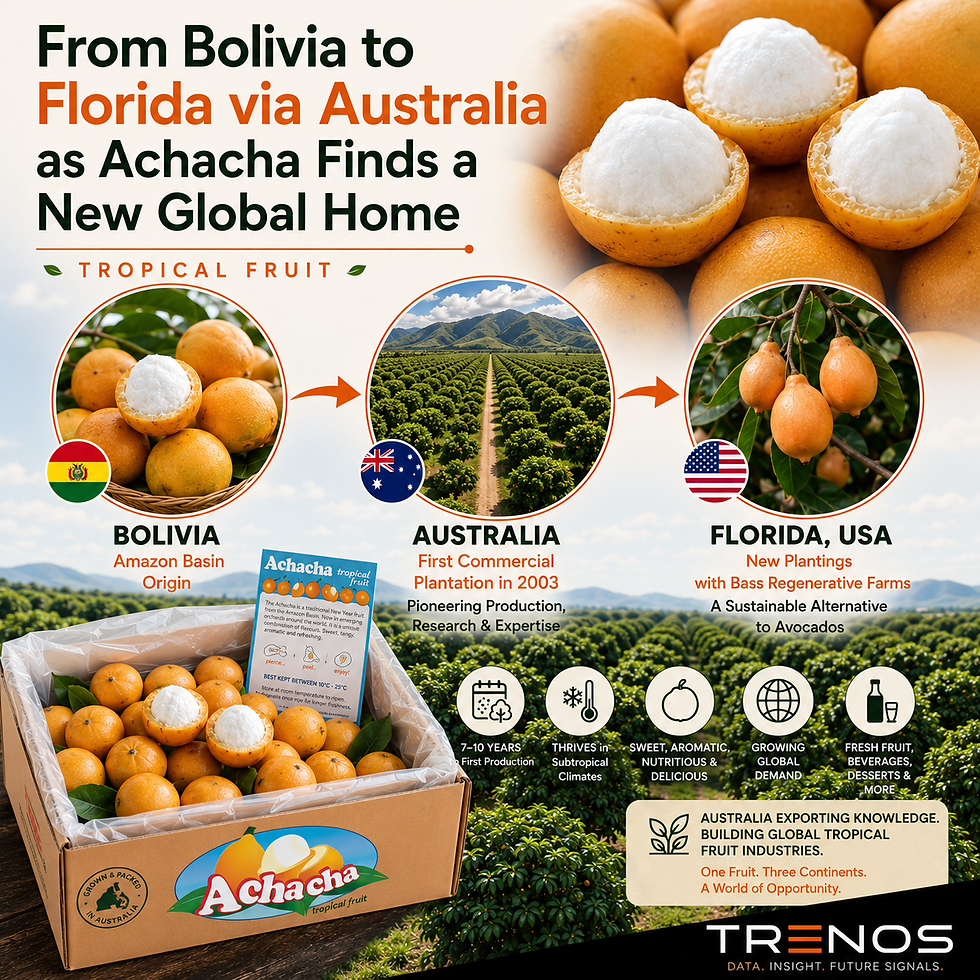
The deeper signal is Australia has quietly demonstrated a repeatable model for creating entirely new horticultural industries. Rather than breeding a new cultivar or expanding an existing commodity, Australian growers identified an under-commercialised species from Bolivia's Amazon Basin, invested more than two decades developing commercial production systems, educated consumers and established export markets. The result is a body of agronomic knowledge that now has commercial value in its own right.
That expertise is now being exported to Florida, where growers facing losses from laurel wilt disease in avocado orchards are adopting achacha as an alternative crop. Australia is no longer simply exporting fruit, it is exporting production knowledge, propagation systems and commercial confidence.
In an era of climate uncertainty, intellectual property increasingly extends beyond plant genetics. It includes knowing what to grow, where to grow it and how to build an industry around it.
Human Factor
Every generation of consumers seems to adopt a new "discovery fruit."
Kiwifruit, blueberries, avocados, dragon fruit and finger limes all moved from niche curiosities to supermarket staples because consumers increasingly seek foods that offer a combination of taste, health, provenance and novelty. Social media, food tourism and premium retail have accelerated that process, allowing previously unknown fruits to build loyal followings far more quickly than in previous decades.
For growers, that changing consumer behaviour reduces dependence on mature commodity markets where margins continue to tighten. Premium fruits with compelling origin stories can command stronger prices while creating opportunities across beverages, desserts, functional foods, agritourism and export branding.
The achacha story demonstrates today's competitive advantage may not lie in producing more of what everyone already grows. It may lie in recognising tomorrow's premium crop while it is still largely unknown.
TRENOS Metrics Snapshot
Metric | Assessment |
Native origin | Amazon Basin, Bolivia |
Commercialisation leader | Australia |
First Australian commercial orchard | 2003 |
First commercial harvest | 2009 |
Florida adoption | Diversification following avocado losses from laurel wilt |
Time to commercial production | Approximately 7–10 years |
Value opportunity | Fresh fruit, beverages, desserts, ingredients, honey, export and agritourism |
Long Play -From Bolivia to Florida via Australia as Achacha Finds a New Global Home
Australia's greatest export may ultimately prove to be horticultural capability rather than horticultural products.
As weather changes, growers around the world will increasingly search for crops capable of replacing traditional production systems under new environmental conditions. Countries investing early in identifying, testing and commercialising overlooked tropical and subtropical species will accumulate valuable intellectual property that can be licensed, exported and replicated internationally.
For New Zealand, particularly Northland and other warming regions, the lesson extends well beyond achacha. The opportunity is to establish systematic evaluation programmes for emerging climate-compatible crops before global demand accelerates. Those who build commercial expertise first are likely to capture the greatest long-term value.
PFN NEWS LINK ENDS:



Comments