
TRENOS SiGINT: New Zealand's Peanut Trials Point To Bigger Food Opportunities

Signal
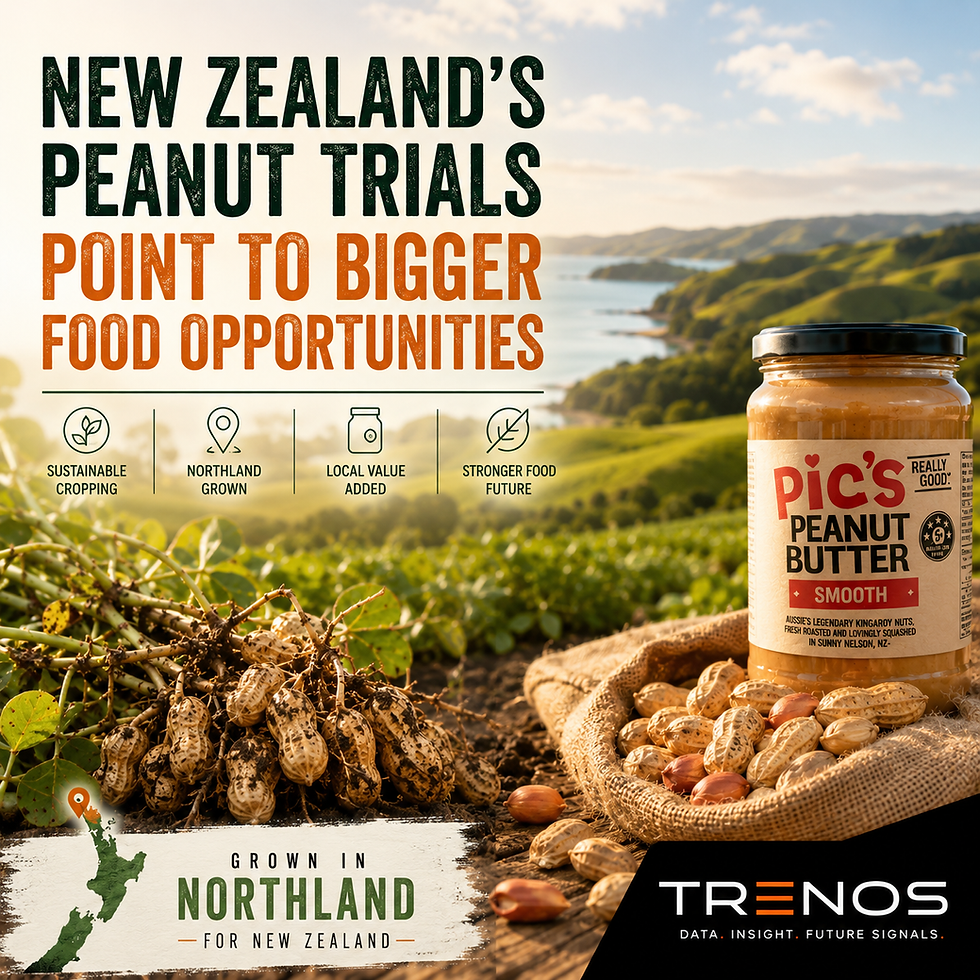
The peanut trials are not really about peanuts although an initial beneficiary will be the popular Kiwi peanut butter brand PIC'S.
They represent another data point suggesting New Zealand's northern regions may support a broader range of higher-value food crops than previously thought. Rather than competing in commodity agriculture, Northland could progressively diversify into climate-adapted specialty crops supplying domestic manufacturers and premium export markets.
Human Factor
Consumers increasingly value food grown closer to home.
Local production reduces transport emissions, strengthens regional resilience and creates stronger connections between growers, processors and consumers. Pic's Peanut Butter has effectively become an anchor customer demonstrating how manufacturers can stimulate entirely new domestic supply chains.
TRENOS Metrics Snapshot
Metric | Assessment |
Climate Adaptation | Strengthening |
Import Replacement | Moderate Potential |
Regional Diversification | High |
Protein Security | Improving |
Food Sovereignty | Positive Signal |
Commercial Readiness | Emerging |
Long Play - New Zealand's Peanut Trials Point To Bigger Food Opportunities
The peanut story opens a much larger strategic conversation. If New Zealand's Northland can reliably produce commercial peanuts, what else becomes possible over the next twenty years?
Climate modelling already suggests northern New Zealand is becoming increasingly suited to crops previously considered marginal. These include chickpeas, pigeon peas, sesame, edamame soybeans, mung beans, cowpeas, bambara groundnuts, macadamias, pistachios, pomegranates, ginger, turmeric, vanilla, cacao (in protected production), coffee, and potentially even selected tropical fruit under evolving production systems. Many are protein-rich or feed directly into high-value food manufacturing.
Rather than asking "Can New Zealand grow peanuts?", a more important national question may become: "What should New Zealand be growing by 2040?"
That shifts the discussion from individual crops to National Opportunity Value - identifying the next generation of foods capable of reducing imports, strengthening food security, creating regional employment and supporting a more resilient bioeconomy.
As we've discussed previously, this is exactly where PFN and TRENOS intersect: beyond the farm lies the strategic redesign of New Zealand's future food system.
ENDS:


Comments