
TRENOS SiGINT: How New Zealand Regulated Away a Billion-Dollar Seaweed Opportunity


Signal:
New Zealand's loss of CH4 Global's commercial seaweed production is being framed as a regulatory dispute. It is much bigger than that.
This is a case study in chronic economic leakage mired in 'fiscal bureaucracy'.
CH4 Global arrived with a solution to one of agriculture's biggest challenges: methane emissions from cattle. The company attracted more than US$100 million in investment, developed commercial-scale Asparagopsis production systems and established operations in Bluff.
Yet while global markets accelerated and Australia built commercial pathways, New Zealand's regulatory framework continued to classify the methane-reducing seaweed product as a veterinary medicine, creating a lengthy and uncertain pathway to local commercialisation.
The result is stark. The science remains. The seaweed remains. The coastline remains. The jobs, investment, manufacturing capability and export growth increasingly do not.
Australia is now positioned to capture the downstream economic benefits of a sector New Zealand was naturally placed to lead.
Human Factor
Most New Zealanders will never visit a seaweed hatchery or understand the finer details of methane-reduction science.
They do understand jobs.
They understand young scientists leaving for Australia.
They understand regional communities missing investment.
They understand tax dollars that could have funded roads, hospitals and schools.
This story is not really about seaweed.
It is about what happens when innovative companies conclude it is easier to build the future somewhere else.
TRENOS Metrics Snapshot
Metric | Assessment |
Signal | Commercial marine biotechnology leaving New Zealand |
Data Point | CH4 Global shifted commercial production focus offshore after regulatory constraints |
Capital Attracted | US$100 million+ |
Industry Type | Marine biotechnology / agricultural emissions reduction |
Technology | Asparagopsis methane-reducing seaweed |
Direct Employment Potential | 100–300 high-value jobs |
Indirect Employment Potential | 300–1,000 jobs across aquaculture, engineering, logistics and manufacturing |
Potential Annual Export Revenue | NZ$100 million–$1 billion+ |
Potential PAYE Contribution | NZ$2–8 million annually |
Potential Company Tax Contribution | NZ$3–15 million annually |
Regional Impact Zone | Southland, coastal aquaculture regions |
Consumer Relevance | Supports lower-emission dairy and beef production |
Trend Classification | Regulatory displacement |
System Pressure Point | Innovation approval pathways lagging market development |
Momentum | Australia ↑↑ / New Zealand ↓ |
Sentiment | Frustration, disbelief, opportunity cost |
Where Signal Is Loudest | Agritech, aquaculture, dairy, biotechnology, export development |
Related Links | Farmers Weekly, Rural News, RNZ, PlanetFood.News |
Economic Leakage Assessment -How New Zealand Regulated Away a Billion-Dollar Seaweed Opportunity
The public discussion has largely focused on methane reduction.
The larger story is economic and it's painfully dismal.
If New Zealand had successfully established itself as a global centre for methane-reducing seaweed production, the country could have captured a meaningful share of a rapidly emerging global market estimated to be worth several billion dollars over the coming decade.
Even a modest 5% participation in a NZ$10 billion global market would represent approximately NZ$500 million in annual revenue.
A 10% participation rate would exceed NZ$1 billion annually.
Over ten years, that equates to billions of dollars in export earnings, hundreds of skilled jobs, millions in PAYE revenue and substantial company tax contributions.
Those figures are not guaranteed.
What is guaranteed is that New Zealand's share becomes harder to capture every year the industry develops elsewhere.
System Pressure Point
The uncomfortable reality is New Zealand may have created a world-leading solution to an agricultural challenge and then regulated itself out of becoming the world's supplier.
Countries such as Norway built global leadership around salmon.
Denmark built enzyme biotechnology.
Singapore is building precision fermentation.
Australia is now building industrial-scale methane-reducing seaweed.
New Zealand had the science, the coastline, the farming expertise and first-mover advantage.
The question policymakers now need to answer is simple: How many more future industries can New Zealand afford to export before they are even built?
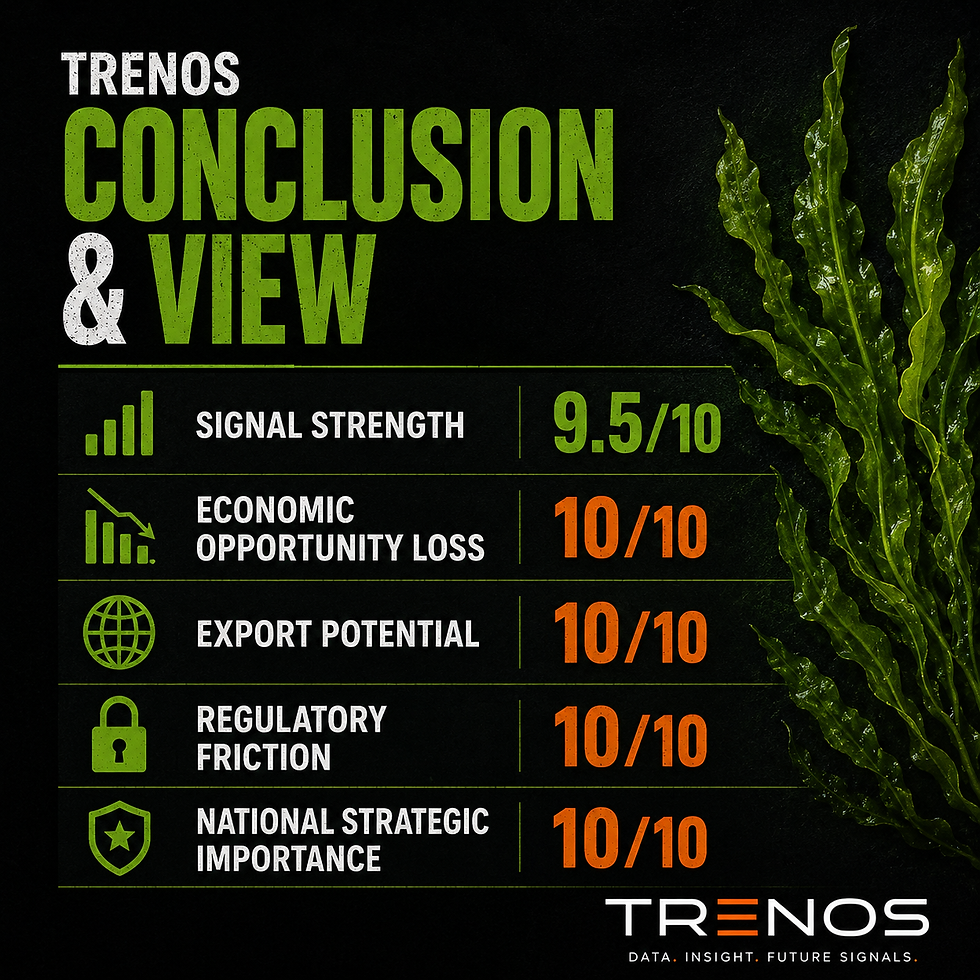
This is not the story of a seaweed company leaving New Zealand. It is the story of a nation potentially forfeiting a future marine biotechnology industry worth hundreds of millions and possibly billions of dollars in annual export earnings.
The real cost may not be measured in tonnes of seaweed, but in the jobs, tax revenue, intellectual property and industrial capability now being created somewhere else. New Zealand's regulatory swamp has to be drained!
ENDS:



Comments